


Development of a Phospholipid Triple-Layer Membrane System: From Understanding Lipid Exchange to Shaping Membrane Asymmetry
Abstract
In this project, we aim at designing a new membrane model system that combines the many advantages of established monolayer methods with the ambitious target not only to develop a triple-layer system at the air-water interface, but also to understand the properties and behavior of the lipids in the individual layers, their exchange between the layers, and how asymmetric and hence more realistic systems can be crafted.
To this end, we will explore methods of assembling lipid bilayers underneath lipid monolayers at the air-water interface. These bilayers can host membrane-spanning molecules such as integral membrane proteins and can be excellent model systems for bilayer and multilayer systems. We will particularly focus on the fate and behavior of the lipids in the system and compare these properties with those of established models. Besides, the structure formed at the air-water will be explored as a model for biological multilayer structures. Here, we will use it as a model to investigate the interplay between lipids and proteins in myelin1)2) with the aim to understand and to target myelin disfunctions in neurological diseases.
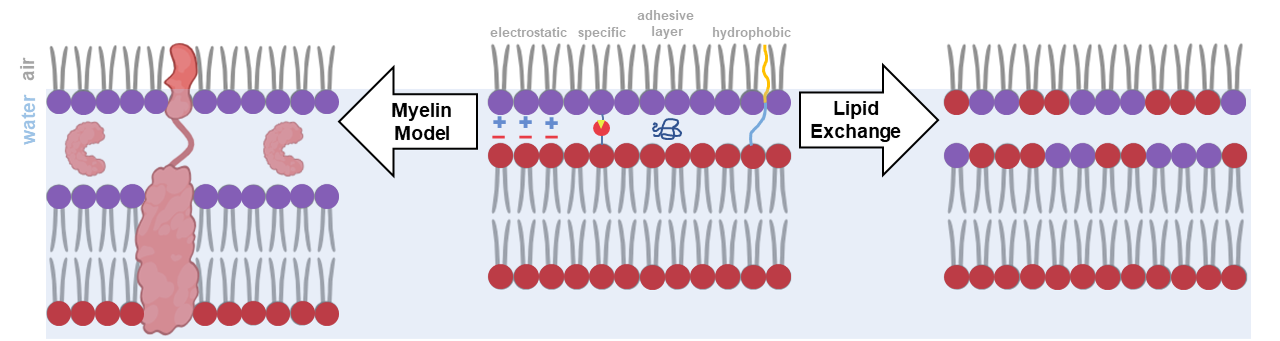
Figure 1. Visions and workflow of the project: Lipid triple-layer assembly at the air-water interface with potential interactions between monolayer and bilayer (middle), lipid transfer across the layers and asymmetry generation (right), and a triple-layer derived model system for myelin (left).
We will use a variety of methods, e.g., film balance measurements, fluorescence microscopy, infrared reflection-absorption spectroscopy3) (IRRAS), and X-ray reflectometry to assess the assembly of the triple layer and the extent of lipid exchange between the layers. We will combine these insights with insights from similar systems not at the air-water interface but in suspension which will be gained by the full armory of electron paramagnetic resonance (EPR) spectroscopy.4)
The acquired knowledge about lipid exchange between the layers can be perspectivally used to understand the implications of bilayer contacts in cell biology and in lipid-based delivery systems, as well as lipid exchange along the delivery routes to the target cells or cellular compartments.
Benefit for the community
This project will establish a novel lipid model system that integrates the strengths of oriented lipid monolayers at the air-water interface with advantages of biologically more relevant bilayer systems. The new triple-layer model provides a complete membrane environment, allowing the incorporation of transmembrane proteins and molecules such as hydrophobic drugs for further studies.
The primary aim is to provide new insights into lipid exchange processes across multiple lipid layers. By systematically investigating the dynamics and mechanisms of lipid exchange between adjacent layers, the project will reveal fundamental principles of interleaflet communication. This can be used in the rational design of lipid-based drug delivery vehicles, where controlled lipid exchange can be exploited to optimize encapsulation, cargo release, and targeting properties. For instance, the developed methods can elucidate interactions between ionizable lipid layers and RNA, which play a role in lipid nanoparticle design for drug delivery.
The project will explore strategies for generating and controlling membrane asymmetry via interlayer lipid transfer, an area of rising significance in phospholipid research.5) We will con-tribute in understanding the mechanisms of asymmetry generation and develop a novel asymmetric model system for further research.
Additionally, the proposed system offers an innovative platform for studying the organization and dynamics of lipid multilayer assemblies, such as those found in myelin.1) This will advance understanding of multilayer membrane function and dysfunction in neurological disorders. Ultimately, the model will be a valuable tool for screening and characterizing therapeutics aimed at stabilizing or rescuing myelin, thus bridging research and pharmaceutical application.
Visit the supervisors lab
Here you can visit Prof. Hinderberger and Dr. Schwieger.

Myelin organization in the nodal, paranodal, and juxtaparanodal regions revealed by scanning x-ray microdiffraction
PLoS One 9, e100592
| PubMed |
Myelin basic protein (MBP) charge variants show different sphingomyelin-mediated interactions with myelin-like lipid monolayers
Biochim. Biophys. Acta Biomembr. 1862, 183077
| PubMed |
Peptide and protein binding to lipid monolayers studied by FT-IRRA spectroscopy
Biochim. Biophys. Acta 1828, 2294–2305
| PubMed |
Influence of different polymer belts on lipid properties in nanodiscs characterized by CW EPR spectroscopy
Biochim. Biophys. Acta Biomembr. 1863, 183681
| PubMed |
Plasma membranes are asymmetric in lipid unsaturation, packing and protein shape
Nat. Chem. Biol. 16, 644–652
| PubMed |