


Development of an enzymatic procedure for microscale synthesis of analytical standards for low-abundant phospholipid species
Prof. Dr. Valery Bochkov1) – University of Graz/Austria
Abstract
The majority of circulating oxidatively modified poly unsaturated fatty acids called oxylipins (OxyL) are esterified in diacyl-phospholipids (OxPLs). While a variety of OxyL are commercially available as analytical standards, only seven can be purchased in the form of OxPLs, and just three of them are deuterium-labeled, which hampers studies on the metabolism, physiological roles, and disease associations of OxPLs.
This project aims to develop a pilot enzymatic procedure to streamline the microscale production of analytical standards of OxPLs for use in lipidomics studies. The procedure will mimic the Lands’ cycle of phospholipid synthesis (Figure 1), including two enzymatic reactions: (i) synthesis of acyl-coenzyme A (acyl-CoA) and (ii) transfer of the acyl residue to monoacyl-phospholipid. These reactions will be performed using commercially available OxyL and monoacyl phosphatidylcholines (PC) as substrates to obtain individual molecular species of OxPCs. Reactions with deuterated monoacyl PC can generate internal standards for mass spectrometry.
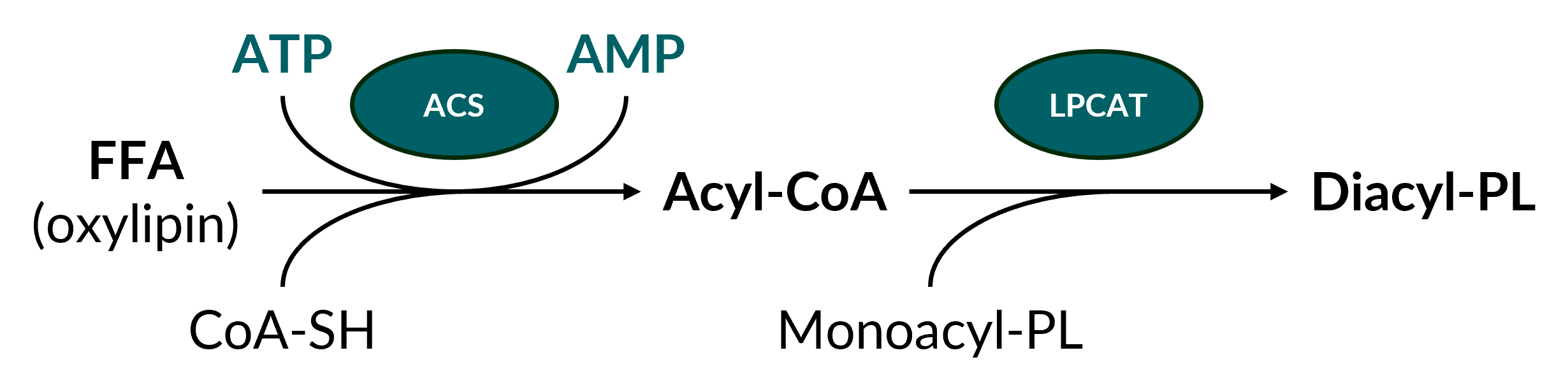
Figure 1. Enzymatic Lands’ cycle. Lands’ cycle proceeds in two sequential steps: i) formation of acyl-CoA from a free fatty acid (FFA) and CoA-SH, catalyzed by acyl-CoA synthetase (ACS); followed by ii) incorporation of acyl-CoA into a phospholipid by lysophosphatidylcholine acyltransferase (LPCAT). This project aims to apply these reactions for the introduction of OxyL into diacyl-PL.
Microsomes from rat liver or cultured cells overexpressing individual enzymes of the Lands’ cycle will serve as enzyme sources. As an alternative “plan B,” OxyL-CoA can be synthesized via a one-pot non-enzymatic reaction. Additionally, synthesis of OxPLs from OxyL and monoacyl-phospholipid can be performed using the reverse reaction of phospholipase A2 in organic solvents. Preliminary experiments have confirmed the feasibility of all three approaches.
The generation of diverse OxPL standards will elevate oxilipidomics to a new analytical level. Absolute quantitative data will enhance understanding of the biological importance of OxPLs and support their application as disease biomarkers.
Benefit for the community
Recent progress in chromatographic techniques and mass spectrometry has created a gap between the number of phospholipid (PL) species that can be detected and the availability of analytical standards, particularly for low-abundant and modified PL molecules. Our innovation aims to address this discrepancy by developing a pilot simplified procedure for PL synthesis that will utilize small amounts of OxyL and affordable commercially available reagents.
Compared to existing methods, our technique offers two key advantages. First, the PL synthesis can be initiated directly from a normal or modified fatty acid and completed in a few straightforward enzymatic steps. Second, the procedure can be conducted on a microscale, enabling the use of commercially available amounts of modified fatty acids, for example OxyL, that are insufficient for chemical synthesis. The development of such a technique will significantly advance progress in lipidomic analysis of low-abundant phospholipid species.
The project is directly relevant to phospholipid research because the new technique will enhance the generation of multiple phospholipid mass spectrometry standards that are currently missing. The generation of new standards will aid in various areas of phospholipidomics, including the analysis of the quality of phospholipid-containing formulations (autoxidation/stability) and their fate in in vivo environments (metabolism/oxidative modification).