


Preparation of phospholipid-stabilized parenteral fat emulsions by premix membrane emulsification
Prof. Dr. Heike Bunjes1) – Technische Universität Braunschweig, Germany
People involved
Christopher Heidenreich (funded by the PRC)
Abstract
Phospholipid (PL)-stabilized colloidal emulsions are well established in parenteral nutrition and as intravenous drug delivery systems. These formulations are usually manufactured by high-pressure homogenization with subsequent autoclaving to achieve product sterility.1) A production process based on membrane extrusion of PL-stabilized emulsions (premix membrane emulsification, PME; Figure 1) could be beneficial, particularly for processing shear-sensitive and thermolabile compounds, as it requires less shear and thus less energy input.2)3) This process may also allow for, or even replace, a subsequent sterile filtration step thus eliminating the requirement for heat sterilization.3)
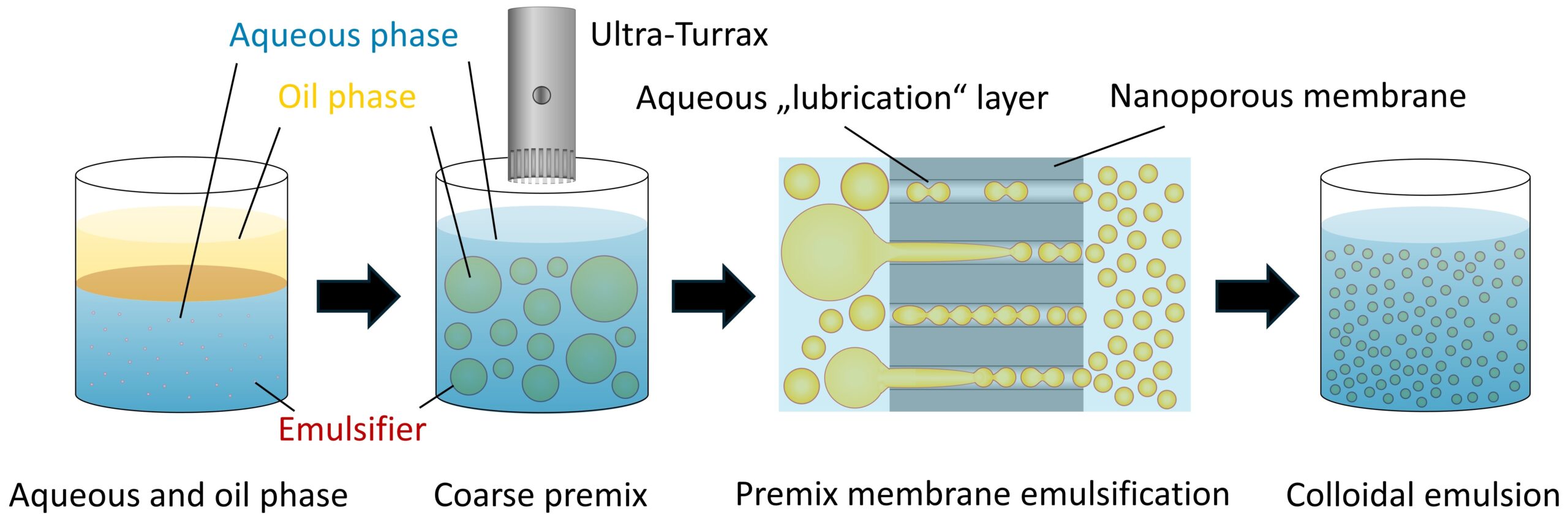
Figure 1. Exemplary workflow sequence for a premix membrane emulsification production run.
Establishing PME for the processing of PL-stabilized colloidal emulsions would thus allow manufacturing such emulsions as carrier systems for sensitive, thermolabile drugs. While PME is well described for the use with conventional emulsifiers, a reliable process for manufacturing PL-stabilized colloidal emulsions has not been established yet. Unique physicochemical properties of PL might be the main cause for a difference in PME performance compared to conventional emulsifiers.
The proposed project aims at establishing PME as a viable and reliable manufacturing method for PL-stabilized parentally applicable emulsions. To achieve this objective, a deeper understanding of the underlying droplet breakup mechanisms, as well as the issues observed in previous PME investigations with PL is needed.4)5) Different physicochemical characterization methods proven effective in analyzing influences on the PME processability of emulsions with conventional emulsifiers will be tested for their viability and validity with regard to PL-stabilized emulsions. Correlating physicochemical properties, such as contact angle, interfacial tension or membrane and emulsion droplet zeta potential, to results obtained in emulsification experiments will help with understanding resulting oil droplet sizes and with revealing potential options for process improvement.
To further enhance the process, changes will be made to the preparation method of the emulsion premix and the composition of the emulsion. Changing PL composition, reducing PL vesicle size, increasing PL concentration or dissolving PL in the oil phase instead of dispersing them in the aqueous phase might improve oil droplet breakup during PME. Furthermore, adding a second, PL-related compound, such as sodium oleate, lyso-PL or PEGylated PL as a co-emulsifier might also increase process efficiency.
Benefit for the community
Phospholipids (PL) are currently the most relevant emulsifiers for intravenously administered emulsions. Their high biocompatibility allows for their application in large quantities, as seen in formulations for parenteral nutrition, where they are very well established. PL are also being used in most of the drug-containing nanoemulsions that have hitherto been introduced to the market.1) Much of the research that is going on in the field of nanoemulsions as drug delivery systems does, however, not necessarily focus on PL as emulsifiers, opening up the option of further expanding their use in this direction.
Enhancing accessibility for PL to be processed by PME
Premix membrane emulsification (PME) is an interesting alternative to high-pressure homogenization for preparing colloidal emulsions suitable for intravenous administration.3) A significant reduction of shear stress exerted onto the product, resulting in less heat dissipation, should be beneficial for the stability of shear sensitive and thermolabile drug substances. As extruding an emulsion through a nanoporous membrane with a pore size smaller than 200 nm can be considered equivalent to a sterile filtration step, this process may remove the requirement of an additional heat and energy intensive autoclaving process, further protecting thermolabile compounds against degradation.
Alternatively, if droplet sizes below 200 nm can be achieved, subsequent sterile filtration could replace the autoclaving process. A reasonable and scalable production rate in combination with the possibility to process emulsions within one extrusion cycle could significantly improve production throughput in the industry while keeping energy consumption, CO2 emissions and finally costs low. PME can, however, not only be used for large-scale industrial applications. Using syringe-based emulsification setups, this process can also be applied with very small product volumes down to the µL-range.2)4) This provides researchers with a comparatively cheap and simple method to test PL-stabilized emulsions as drug carriers for costly and scarce new active substances. The small production volume could also allow for testing new, expensive PL-based excipients for drug carrier optimization. As the method is easily scalable, transitions from simple, low volume screening to development and finally production should be quite straightforward.
Understanding the droplet breakup of PL-stabilized emulsions
PL display unique self-assembly properties in comparison to conventional emulsifiers. Further investigating their adsorption behavior to new interfaces, such as membranes or unstabilized oil-water interfaces during droplet breakup, will help with explaining process efficiency for PME, but most likely also for other emulsification techniques. Altering the way of PL incorporation and emulsion composition prior to PME, as well as analyzing their influence on interfacial properties, will reveal critical process dependencies on interfacial adsorption phenomena and supply of stabilizing agent to water-membrane and unstabilized oil-water interfaces.
Performance of PL-related compounds in emulsification processes
The addition of PL-related co-emulsifiers to PL-stabilized emulsions might significantly alter their physicochemical properties, depending on added quantity. The functionalization of stabilized interfaces, e.g., by increasing the zeta potential, but also differences in solubility and the ability to form mixed colloidal structures with PL in the aqueous phase indicate potential to modify stabilizing capabilities and thus to influence process efficiency for emulsions containing such compounds.
Lyso-PL are one of the most interesting candidates for this application due to their close chemical relationship to “normal” PL. Investigating their performance as co-emulsifier or even main stabilizing agent in colloidal emulsions could help with further establishing these compounds in the pharmaceutical industry.
Visit the supervisors lab
Here you can visit Prof. Dr. Heike Bunjes.

Drug delivery and drug targeting with parenteral lipid nanoemulsions - A review
J. Controlled Release 223, 85–98
| PubMed |
Preparation of nanoemulsions and solid lipid nanoparticles by premix membrane emulsification
J. Pharm. Sci. 101, 2479–2489
| PubMed |
Comparison of Three Processes for Parenteral Nanoemulsion Production: Ultrasounds, Microfluidizer, and Premix Membrane Emulsification
J. Pharm. Sci. 108, 2708–2717
| PubMed |
Preparation of lipid nanoemulsions by premix membrane emulsification with disposable materials
Int. J. Pharm. 511, 741–744
| PubMed |
On the preparation of lecithin-stabilized oil-in-water emulsions by multi-stage premix membrane emulsification
Journal of Food Engineering 89, 164–170
| ScienceDirect |