


EUFEPS-SITELF Meeting
PRC Session “Phospholipids in Drug Delivery” at the EUFEPS-SITELF Meeting 2026
The Joint EUFEPS–SITELF Meeting 2026, titled “Advances in Pharmaceutical Sciences,” took place in Naples, Italy, from May 27 to 29, 2026. As part of the scientific program, the Phospholipid Research Center organized a dedicated session on “Phospholipids in Drug Delivery,” highlighting current developments in phospholipid-based formulation research and pharmaceutical applications.
The session was introduced by Simon Drescher, who presented the Phospholipid Research Center and outlined selected current PRC activities and research directions. The introduction focused on the molecular versatility of phospholipids as pharmaceutical excipients and functional materials. Due to their amphiphilic structure, physiological occurrence, biocompatibility, and broad technological functionality, phospholipids can serve as emulsifiers, wetting agents, solubilizers, matrix-forming excipients, and building blocks of advanced drug delivery systems such as liposomes, lipid nanoparticles, emulsions, and mixed micelles. The introductory lecture framed the session by showing how phospholipid research connects molecular design, formulation technology, biological performance, and translational relevance.
Following the PRC introduction, Peter Hölig from Lipoid GmbH gave a brief overview of GMP-grade phospholipids for pharmaceutical applications. This contribution underscored the importance of high-quality phospholipid excipients for the development and manufacture of pharmaceutical formulations.
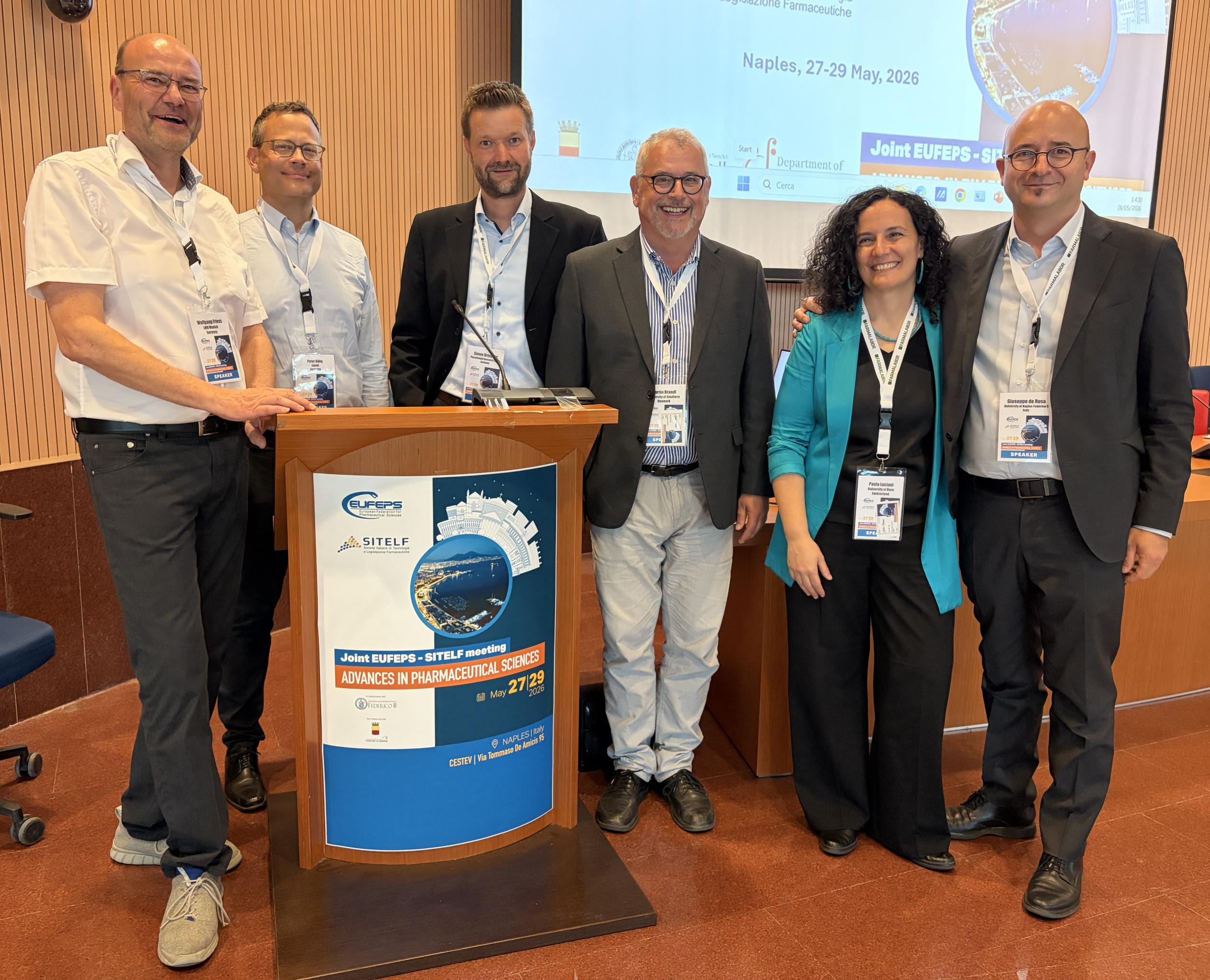
PRC Session “Phospholipids in Drug Delivery” at the Joint EUFEPS–SITELF Meeting 2026 in Naples, Italy. From left to right: Wolfgang Frieß, Peter Hölig, Simon Drescher, Martin Brandl, Paola Luciani, Giuseppe De Rosa.
The scientific part of the session featured three invited lectures by researchers who had previously served as principal investigators in PRC-funded projects.
Prof. Dr. Martin Brandl from the University of Southern Denmark, Odense, presented “Phospholipid-based amorphous solid dispersions – Elucidating the mechanism of oral drug absorption-enhancement”. His lecture addressed phospholipid-based amorphous solid dispersions as candidate-enabling formulations for poorly water-soluble drugs. A particular focus was placed on the mechanistic evaluation of oral absorption enhancement, including the role of colloidal species formed during dissolution and digestion. The work highlighted the value of microdialysis sampling for determining molecularly dissolved drug concentrations and for improving the mechanistic understanding of in vitro-in vivo correlations.
Prof. Dr. Paola Luciani from the University of Bern presented “Injectable Liposomal Depots: A Bottom-Up Journey from In Silico to In Vivo”. Her lecture focused on phospholipid-based injectable depot formulations, particularly for subcutaneous and intra-articular applications. The presentation described the development of thermoresponsive in situ-forming liposomal depots, in which liposomes assemble into a cohesive depot upon exposure to physiological polyvalent cations. The work combined computational modeling, physicochemical characterization, ex vivo and in vitro testing, and translational in vivo evaluation. It also addressed animal-sparing approaches in line with the 3R principles.
Prof. Dr. Wolfgang Frieß from Ludwig-Maximilians-Universität München presented “Proteins at the Interface – Monoacyl Phospholipids to the Rescue”. His lecture addressed the use of monoacyl phospholipids as potential alternatives to polysorbates in parenteral protein formulations. The work showed that monoacyl phospholipids can protect therapeutic proteins against interfacial stress by displacing protein molecules from air-water and silicone oil-water interfaces. The results indicated that selected monoacyl phospholipids may provide interfacial stabilization comparable to polysorbates, while offering potential advantages with regard to degradation-related quality concerns.
Overall, the PRC session demonstrated the breadth of phospholipid-based formulation research, ranging from oral bioavailability enhancement and injectable depot systems to the stabilization of therapeutic proteins. With more than 120 participants despite three parallel sessions, the session was very well attended and confirmed the strong interest in phospholipids as versatile excipients and functional materials in advanced drug delivery.